The Shipment Performance dashboard provides a comprehensive financial and operational view of your shipping activities. It enables you to analyze shipping costs, monitor transit times, and evaluate the efficiency of your fulfillment channels.
This article explains the data displayed on the dashboard, including metric definitions and usage context.
 |
For a list of available dashboards and instructions to access them, see Insights Dashboards Master List [Guides List]. To learn how to filter, view details, and export data from this dashboard, refer to: How to Use the Insights Dashboards [Guide].
|
TABLE OF CONTENTS
Purpose
You can use this dashboard for deep financial analysis and logistics optimization by:
Monitoring total shipping spend and cost-per-shipment trends.
Comparing transit times across different Accounts and Channels.
Identifying the ratio of shipping costs relative to order value.
The table below summarizes its key aspects:
FEATURE | SHIPMENT PERFORMANCE |
| Primary Focus | Shipping cost analysis, transit speed performance, and shipment volume tracking. |
| Best For | Financial planning, carrier negotiation prep, and identifying high-cost or slow-moving channels. |
| Highlighted Metrics |
|
| Typical Questions |
|
| Typical Users |
|
Components
Key components:
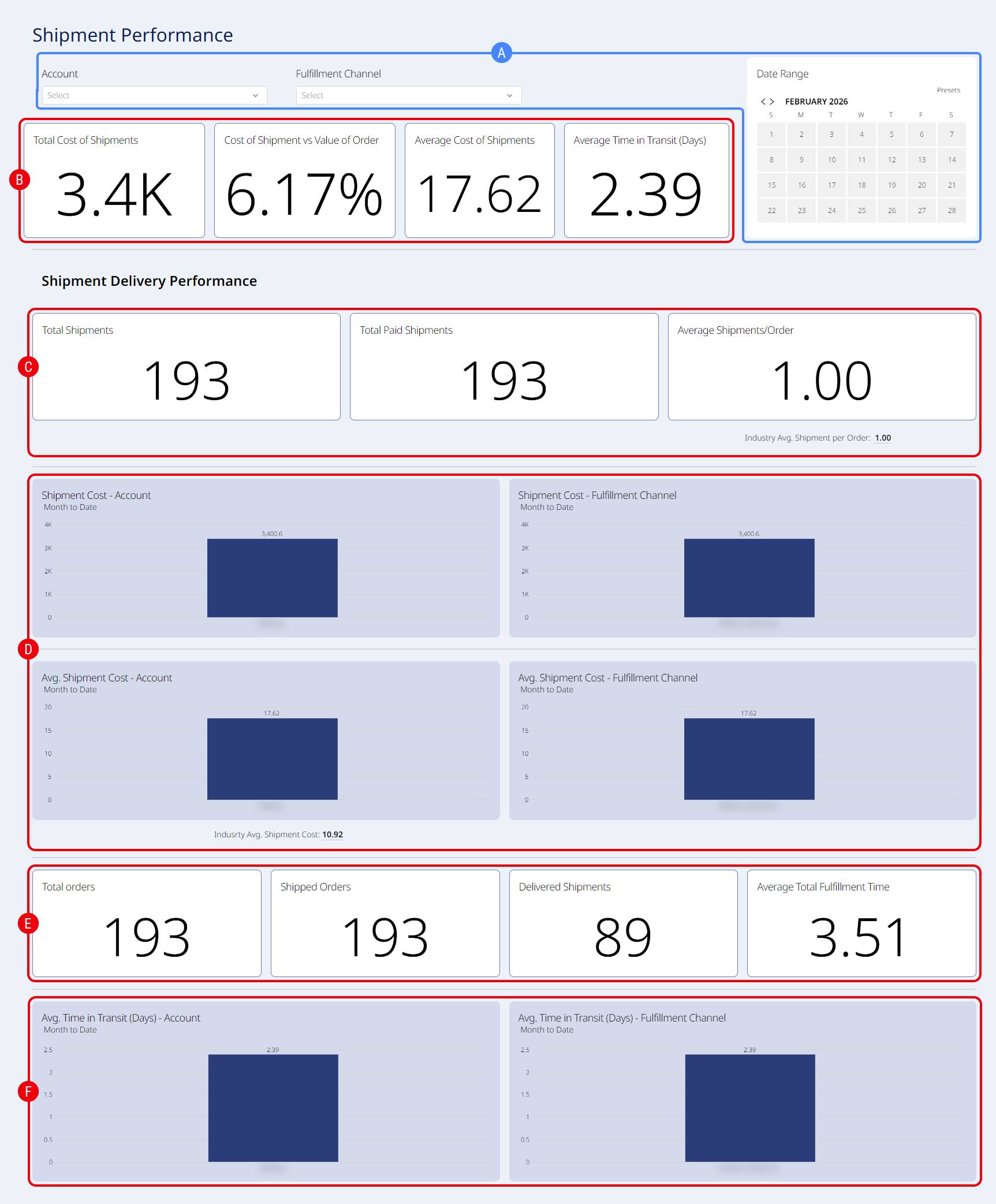
 | Embedded Filters: Filter by Fulfillment Channel, Date Range, Account, or a combination. |
 | Summary: Displays high-level Key Performance Indicators (KPIs) regarding cost and speed. This section includes: |
Total Cost of Shipments: The sum of all shipping expenses incurred for the selected period.
Cost of Shipment vs Value of Order: The ratio of total shipping costs compared to the total value (revenue) of the orders.
Average Cost of Shipments: The mean shipping cost per individual shipment (calculated only for shipments where cost is recorded).
Average Time in Transit (Days): The average number of days elapsed between the shipment induction (carrier pickup) and the delivery date.
 | Shipment Volume: Provides a breakdown of shipment counts and ratios. This section includes: |
| The Industry Avg. metrics displayed across select components represent the global aggregate data across all active techOMS accounts. These benchmarks calculate data over a rolling 90-day period. | |
| | ||
- Total Shipments: The total count of all shipments that have been shipped.
- Total Paid Shipments: The count of shipments that have a recorded freight cost greater than zero.
- Average Shipments/Order: The average number of shipments generated per sales order. A value higher than 1 indicates frequent split shipments. This tile also displays the Industry Avg. Shipment per Order.
 | Cost Analysis: Breaks down financial metrics by specific business segments. This section includes: |
Shipment Cost - Account: The total shipping spend grouped by Account.
Shipment Cost - Fulfillment Channel: The total shipping spend grouped by Fulfillment Channel.
Avg. Shipment Cost - Account: The average cost per shipment for each account. This chart also displays the Industry Avg. Shipment Cost, which strictly excludes shipments with missing or zero shipping costs to maintain data accuracy.
Avg. Shipment Cost - Fulfillment Channel: The average cost per shipment for each Fulfillment Channel.
 | Order & Fulfillment Status: Correlates shipment data with overall order progress. This section includes: |
Total orders: The count of all unique orders received.
Shipped Orders: The count of unique orders that have been fully dispatched.
Delivered Shipments: The count of shipments that have been successfully marked as delivered.
Average Total Fulfillment Time: The average time from order creation to final delivery.
 | Transit Time Analysis: Focuses on the speed of delivery across your network. This section includes: |
Avg. Time in Transit (Days) - Account: The average transit time (in days) grouped by Account.
Avg. Time in Transit (Days) - Fulfillment Channel: The average transit time (in days) grouped by Fulfillment Channel.
Was this article helpful?
That’s Great!
Thank you for your feedback
Sorry! We couldn't be helpful
Thank you for your feedback
Feedback sent
We appreciate your effort and will try to fix the article