The Pickup Schedule is a centralized operational calendar within techSHIP designed to manage your warehouse's pickup availability. By configuring this tool, you ensure that your reporting dashboards reflect highly accurate parcel departure times.
Prefer listening? You can download the podcast-style audio attached to this article, which walks you through the key points.
 | AI-Assisted & Human-Reviewed: For general information only. Please double-check important details. | |
| | ||
This article explains the internal mechanics of the centralized calendar, the importance of maintaining an accurate schedule, and how the system calculates expected induction times for your shipments.
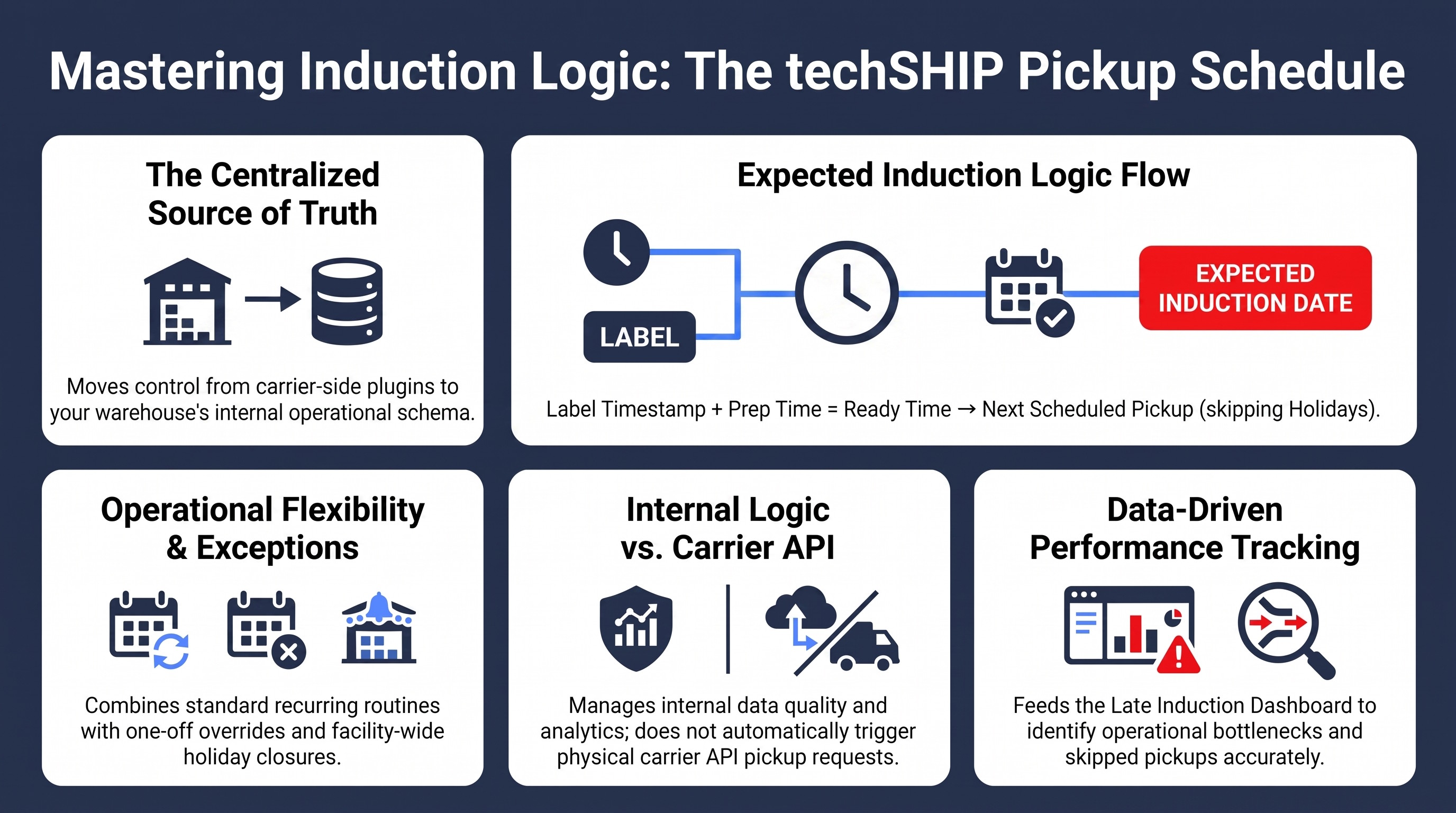
TABLE OF CONTENTS
- Prerequisites and Feature Activation
- The Importance of the Centralized Calendar
- Expected Induction Date Calculation Logic
Prerequisites and Feature Activation
Before utilizing the centralized calendar under the Carriers menu, you must enable the core functionality at the facility level. Once activated, techSHIP assumes absolute control over your carrier induction logic, shifting the source of truth from individual carrier plugins to your warehouse's internal operational schema.
For instructions on how to activate this module, refer to Managing General Pickup Settings & Holidays [Step-by-Step Guide].
The Importance of the Centralized Calendar
Maintaining an up-to-date Pickup Schedule is critical for operational visibility. This calendar functions purely as an internal planning schema to calculate accurate induction estimates for your post-induction reporting. By defining your true operating hours and facility Holidays, you prevent reporting inaccuracies—such as theoretical weekend shifts or after-hours pickups—ensuring that your delivery performance tracking remains realistic and actionable for the business. To set your facility's global operating hours and preparation times, refer to Managing General Pickup Settings & Holidays [Step-by-Step Guide].
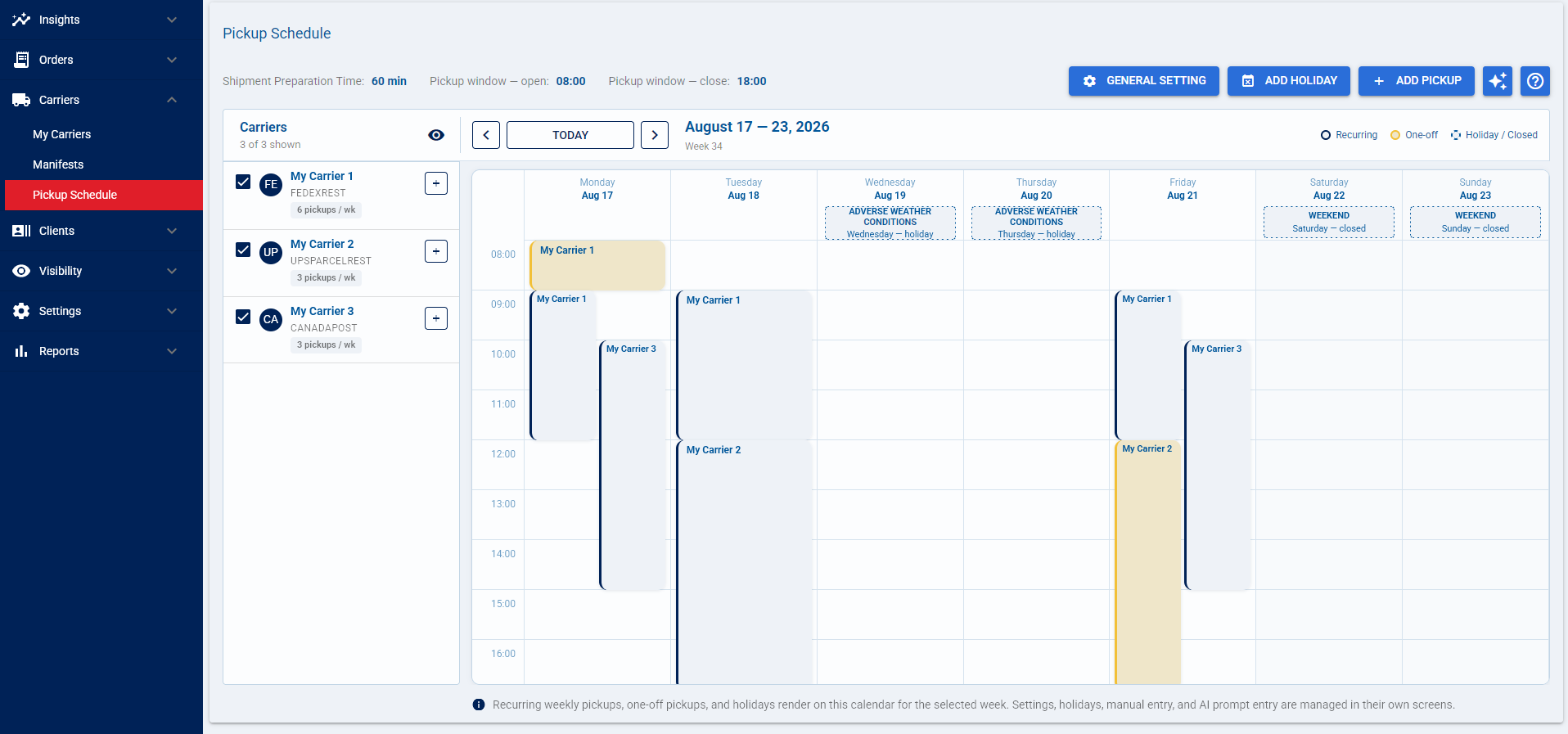
This centralized model applies equally to all your active carriers. Whether they support electronic scheduling or not, you can configure their schedules identically. To define standard weekly schedules or one-off exceptions for individual shipping partners, refer to Configuring Carrier Pickup Schedules & Exceptions [Step-by-Step Guide].
| The Pickup Schedule operates independently from the carrier integration and is designed exclusively for internal operational control, data quality, and accurate analytics within techSHIP. Configuring this calendar does not automatically schedule physical pickups with your carrier (via API) or your Host System. | |
| | ||
Expected Induction Date Calculation Logic
To provide trustworthy metrics, techSHIP synthesizes real-time warehouse activity with your configured schedule. The system executes the following logical flow to determine the final induction estimate:
- Label Generation Timestamp: The system captures the exact moment you process the order and generate the shipping label.
- Shipment Preparation Time: The system adds your pre-configured location handling duration (e.g., 60 minutes) to the generation timestamp to determine the true Ready Time.
- Expected Induction Date: The system scans the calendar to find the next available scheduled pickup window for that specific carrier that occurs on or after the Ready Time, strictly skipping any defined facility Holidays.
The calculated Expected Induction Date directly feeds the Insights reporting module, providing a definitive source of truth for when parcels physically leave your facility. This robust data foundation empowers you to identify carrier compliance issues and internal delays accurately.
| For detailed conceptual information on how you can use this data for business intelligence analysis, refer to Understanding the Late Induction (Late Delivery) Dashboard [Information]. | |
| | ||
Was this article helpful?
That’s Great!
Thank you for your feedback
Sorry! We couldn't be helpful
Thank you for your feedback
Feedback sent
We appreciate your effort and will try to fix the article